Transcript editing · 7 min read
Clean Verbatim vs Full Verbatim: What Should You Keep?
Compare clean and full verbatim transcription with worked examples. Decide when to keep fillers, corrections, repetition, and uncertainty in a transcript.
By Zhang at Wordtake. Zhang works on Wordtake and writes about transcript review. This guide uses invented examples and published style guidance; it is not a transcription benchmark.
Choose a style before you start deleting words
Clean verbatim transcription removes selected speech clutter while preserving what the speaker means. Full verbatim keeps more of how the words were spoken, including fillers, repetitions, and false starts. Neither label is a complete editing specification: agree on the details before ordering a transcript or cleaning an automated draft.
This guide is for editors turning interviews, meetings, or teaching recordings into reading copies. It compares editing choices, not software accuracy. The practical test is whether a deletion changes an answer, degree of certainty, correction, or speaker interaction. If it does, keep the relevant wording and check the recording.
Key Takeaways
- Use clean verbatim for a reading copy when speech clutter is not part of the information you need.
- Use a detailed verbatim specification when delivery, hesitation, or interaction matters to the project.
- Keep uncertainty, negation, meaningful repetition, and corrections that affect the answer.
- Save the source recording and label the editing style. A summary belongs in a separate section.
What do clean and full verbatim mean?
Clean verbatim is a lightly edited transcript, not a rewritten account. Rev’s human-transcription documentation describes its standard output as edited for readability without paraphrasing; its verbatim option includes fillers, false starts, stutters, and laughter. That is one provider’s specification, not a universal rule for every transcript.
For a project brief, replace a vague request such as “make it verbatim” with specific instructions. Say whether you want repeated words, abandoned phrases, pauses, overlapping speech, and meaningful non-speech sounds marked. Specify how to label an unclear word. The person checking the transcript then has something observable to verify.
A full verbatim label also does not guarantee that every acoustic detail is represented. A pause can be a simple bracketed note or a measured duration, depending on the project. An interview archive and a conversational analysis project may need different levels of notation. Ask the recipient what the text must preserve before choosing the style.
Compare one answer in both styles
The following invented exchange illustrates an editorial decision. It is not a recording, customer result, or measurement of an automated service. The speaker is uncertain about a delivery date; that uncertainty is part of the answer.
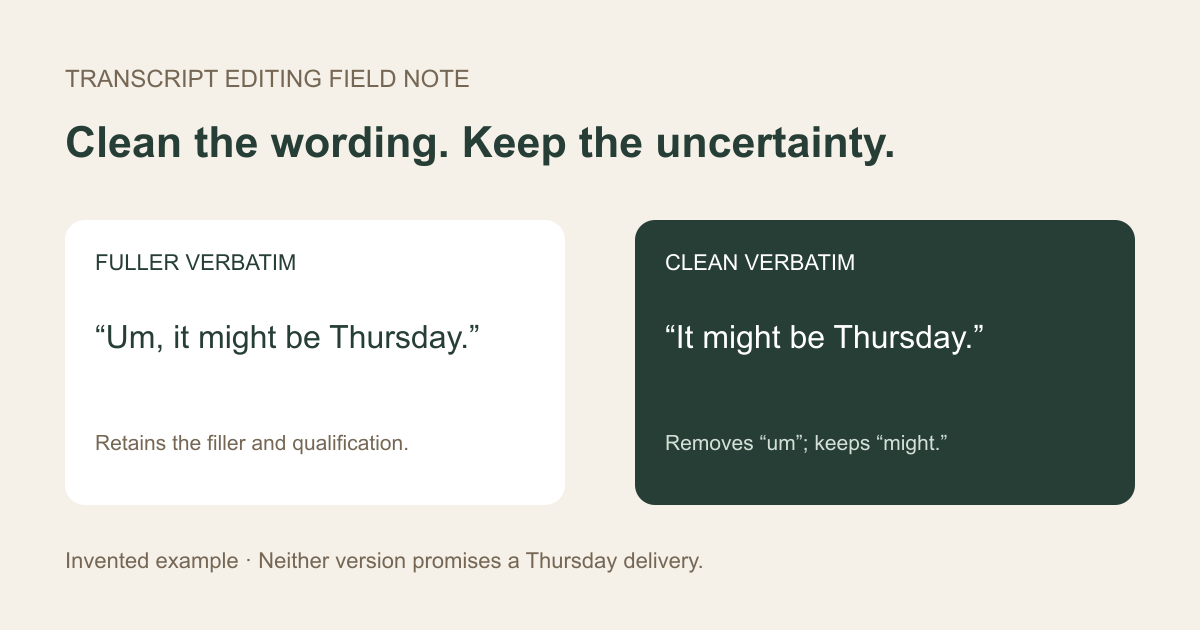
Fuller verbatim example — Interviewer: “Is delivery on Thursday?” Speaker: “Um, it might be Thursday. I, I still need to check with Jo.”
Clean verbatim example — Interviewer: “Is delivery on Thursday?” Speaker: “It might be Thursday. I still need to check with Jo.”
Over-edited version — Speaker: “Delivery is Thursday.” This is a paraphrase that turns a possibility into a commitment. It removes both “might” and the need to check. It should not be presented as the speaker’s transcript.
The clean version removes the filler and repeated “I” while retaining the answer’s conditions. That is the useful boundary: improve the reading experience without increasing the speaker’s certainty. When a deletion feels convenient, compare the before-and-after wording as if someone will act on it.
Which words are safe to remove?
There is no reliable delete-all list. A sound or phrase may be disposable in one sentence and meaningful in the next. Apply the agreed style to a passage after listening to it, then check whether the remaining words still support the same interpretation.
In another invented example, “We need, um, a larger room” can become “We need a larger room” in a reading copy. But “Um… I am not sure we should proceed” contains hesitation next to a decision. If the project examines how the decision was made, retain the hesitation under its notation rules.
Treat “like,” “you know,” and “right” as context-dependent words. “It looks like glass” is a comparison, and “Turn right” is an instruction. A global replacement cannot distinguish these from conversational fillers. Review candidates individually rather than silently deleting every match.
- Filler without a meaning change: consider removal in the reading copy.
- Negation or qualification: retain words such as not, might, probably, and approximately.
- Repeated emphasis: keep wording such as “very, very difficult” when the emphasis matters.
- An answer from another speaker: retain it as a speaker turn, even if it is only “yes.”
How should you handle corrections and false starts?
Keep a correction when it explains a changed answer or prevents a misleading reading. In this invented sentence, “We sent fifteen—sorry, fifty invitations,” the corrected number is fifty. A clean reading copy might retain “We sent fifty invitations” if the brief allows false starts to be removed and the correction itself is not relevant. A detailed reference copy should preserve the correction.
Now consider “I approved—no, I reviewed the application.” Reducing that to “I reviewed the application” hides the speaker’s self-correction. If the distinction between approval and review is important to your interview, retain both phrases. The point is to make an explicit decision, not to assume all abandoned words are harmless.
Keep an edit note or a timed reference for passages where a correction affects a name, number, date, or responsibility. When you cannot tell what the final intended word is, mark the uncertainty and replay the passage. Do not reconstruct a confident answer from surrounding context alone.
Choose the level of detail for the reader
For an internal reading copy, a light cleanup may make a long answer easier to follow. For a project studying hesitation, turn-taking, or speech patterns, removing those features can remove the material being examined. Treat those as different deliverables, and agree on the notation with the person who will use them.
Baylor University’s Institute for Oral History encourages people to adapt its transcription style guide and explains that a transcript cannot capture the whole recorded exchange. Its guidance covers false starts, interruptions, nonverbal sounds, and unclear speech. Keeping access to the recording remains useful even when the text has been carefully edited.
For accessible media, decide what audio and visual information the reader needs separately from the clean-versus-full label. W3C WAI describes basic transcripts as including speech and non-speech audio needed for understanding; descriptive transcripts add needed visual information. Removing a meaningful alarm or an unseen speaker’s response can therefore lose context even in a readable transcript.
A transcript intended for publication may also need editorial review and a clear explanation of what was changed. Check quotations against the recording, preserve context, and follow the publication’s own rules. Do not treat a polished sentence as a verified quotation merely because it reads naturally.
Baylor: oral history resources and transcription style guide
Write a brief that another editor can follow
An editing brief should describe the output and its limits. The following example is a starting point for a reading copy, not a standard for every organization. Change it when the purpose requires finer detail.
Example brief: “Create a clean verbatim reading copy. Remove non-meaningful fillers and accidental repeated words. Preserve uncertainty, negation, meaningful emphasis, and corrections that affect interpretation. Keep speaker changes. Mark unclear speech with a timestamp. Keep a separate source copy and record substantial editorial decisions.”
Add a short disclosure to the finished page, such as “Lightly edited for readability; fillers and accidental repetition removed.” If you also prepare takeaways, label them as a summary rather than inserting them into the transcript. Keep the original wording available when a reader or colleague needs to check the edit.
Review the result before calling it final
Compare high-risk passages with the recording: decisions, commitments, figures, technical terms, and speaker changes. Then read the cleaned copy on its own. If an answer sounds more certain, more fluent, or more complete than the source supports, revisit the edit.
An automated draft is a starting point for this review. Choosing a style after transcription does not recover words already missing from the draft; the recording is still needed. Use a consistent speaker label when identity is unknown and resolve uncertainty openly rather than inventing a name.
Keep two clearly named versions when the project needs both fidelity and easy reading: a checked reference transcript and an edited reading copy. The next useful step is a source-checking pass, using the checklist linked below, before distributing either version.
- The chosen style and removed elements are disclosed.
- No uncertainty or negation disappeared during cleanup.
- Corrections still support the speaker’s intended answer.
- Speaker turns and meaningful sounds remain understandable.
- Unclear passages are flagged instead of guessed.
- A source recording and reviewable reference copy remain available.